

A conversation with Salvatore Leo, Co-Founder and CEO of Royal Biologics
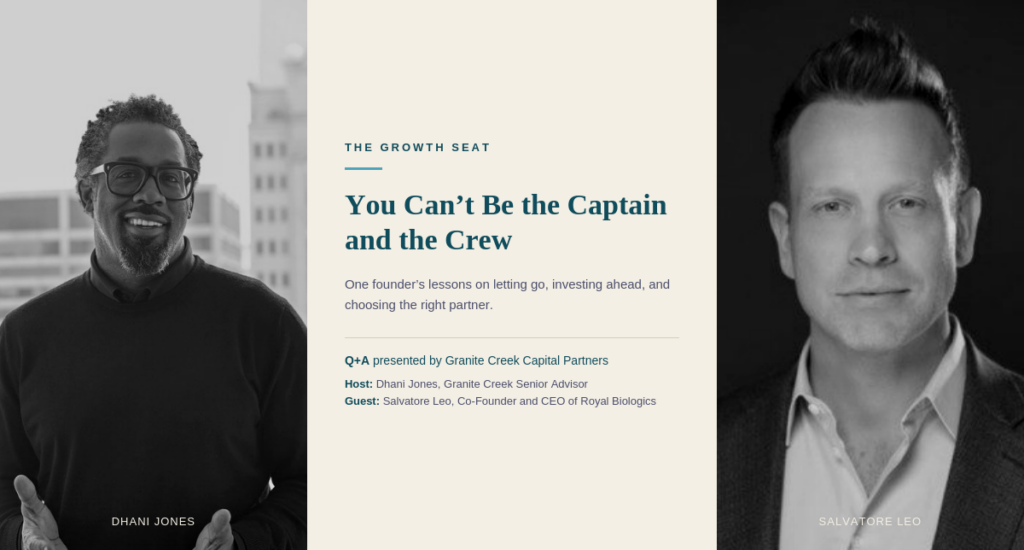
Granite Creek Senior Advisor Dhani Jones sat down with Salvatore Leo to talk about scaling a founder-led business, the uncomfortable stretch of over-investing before returns materialize, and narrowing in on what separates value-add capital partners worth signing with from those who simply write checks.
Salvatore (Sal) Leo built Royal Biologics from scratch — no investor capital or financial backing, just a clear vision for what regenerative medicine could become. Founded in 2016 and headquartered in New Jersey, Royal Biologics (Royal) is a medical device company that develops, licenses, produces, and distributes orthobiologics products used in surgical procedures in a variety of clinical settings, including orthopedic, sports medicine, spine, wound care, and regenerative applications. Royal’s devices are used in a wide range of clinical settings including orthopedic, sports medicine, spine and regenerative applications.
Sal co-founded Royal Biologics with Demetrios Soteropoulos, drawing on more than 30 years of shared medical device experience. Before launching Royal, Sal spent many years as an operating room consultant, spine device sales manager, and pharmaceutical sales representative — building a ground-level understanding of the industry, from what surgeons need to where the market has room to improve and grow. Today, Royal Biologics is a portfolio company of Granite Creek Capital Partners.
When Your Greatest Strength Becomes Your Ceiling
Dhani Jones: You’ve been building Royal Biologics for over 15 years. When you look back, was there a defining moment — a decision or a shift — that put the company on its current trajectory?
Salvatore Leo: I don’t think there was one definitive day. It’s more of a cumulative effect — and really, it comes down to surrounding yourself with the right people. When you start something, you want to own it all. You want to control everything. You want to micromanage everything. And I started reading about founders like Steve Jobs and Bill Gates, and I realized the moments where they really took things further was when they started to let go and empower the people around them. I can’t do everything — but I can be the captain of the ship. Once I started bringing talented people in and genuinely trusting them with the vision, growth accelerated. The business stopped being limited by one person’s bandwidth and started running on collective momentum.
Dhani Jones: That’s a hard call. A lot of founders get it intellectually and still can’t make themselves do it. Was letting go the hardest call you made while scaling?
Salvatore Leo: It was hard. But I’d say it wasn’t the hardest. The hardest moments are different — and they come later.
Before It Gets Better, It Gets Worse
Dhani Jones: So what was harder? What’s the moment in scaling that actually tests you — the one most founders aren’t prepared for?
Salvatore Leo: There’s a point in every growing business where you have to over-invest — in people, in infrastructure, in a clinical trial or a capability that won’t pay off for 12, 18, 24 months. And that’s exactly when the numbers look wrong. EBITDA looks wrong. The timing feels wrong. And if you have investors, it can look frightening, because people want a return on their capital. You have to stand up and say: you’re not going to see this now, but it will bear fruit. You’re just going to have to trust me — I’ve gotten you this far. That’s a lonely island to be on. You have a vision, you’re trying to get buy-in, and you can’t always quantify what you’re asking people to believe in. But the founders who can hold that line — who know the difference between recklessness and calculated conviction — those are the ones who come out on the other side.
Dhani Jones: How do you know when you’re being convicted versus just stubborn? When do you hold the line, and when do you reassess?
Salvatore Leo: Sometimes you can see beneath the surface, and other people can’t — but you believe in the culture, the energy, the direction. And sometimes you can’t explain that. You can’t quantify it. You can’t make it something you can put in someone’s hand and read. But when you can feel what’s going on beneath the surface, that’s what you have to be willing to roll the dice on. I’ve always been a little aggressive on that front. I’d rather bet on a vision I believe in than play it safe and find out later I was right.
Choosing the Right Capital Partner
Dhani Jones: When Granite Creek came along, you had options. A lot of founders in that position default to check size. What made Granite Creek stand out, and what guidance would you give another founder choosing a capital partner?
Salvatore Leo: You have to think about who you want sitting across from you at a board meeting for the next five or six years — and what that relationship looks like under pressure. I wanted to surround myself with people who had real business acumen and who were going to coach me. What I saw early in conversations with Granite Creek was that they understood what I was trying to build. And they challenged me. I was running a 30-day horizon — what’s closing this month, what’s in front of us right now. Granite Creek taught me to think in 12-, 24-, 36-month windows. What problems are coming that we haven’t started solving yet? What infrastructure do we need to build before we need it? That’s a different way to lead, not just a different way to finance.
Dhani Jones: When you actually signed — ink on paper — what was the first thing that went through your mind? And the last?
Salvatore Leo: First thing: now I have the resources, the team, and the capital to execute the vision. I had a sounding board. A safety net. People to lean on. The last thing I thought was — I better not screw this up.
On staying sharp — and what drives the engine
Dhani Jones: You’re coachable, you’ve built the team, you have the capital partner. What’s the habit or ritual that keeps you sharp day to day?
Salvatore Leo: I have to get in the gym before the day starts. Sixty minutes — lifting, cardio, whatever it is. That solo time is where I do my real thinking. All day it’s calls, meetings, and emails. But in the gym, I can self-reflect. I challenge my own decisions. I ask myself, is this right, is this not? And then I sit down and do the work. I’ve also been reading a book called The 38 — it’s a collection of letters from John D. Rockefeller to his son. Every letter has a principle. Some of them are simple: if you’re on time, you’re late. There’s no free lunch. My first boss in finance told me something I’ve never forgotten: the world doesn’t care about you. You need to make the world care about you. I think when you boil down how successful founders actually got there, it comes back to the same basket of principles. Get up, do the work, face adversity, and empower the people around you. That’s what keeps the engine running.